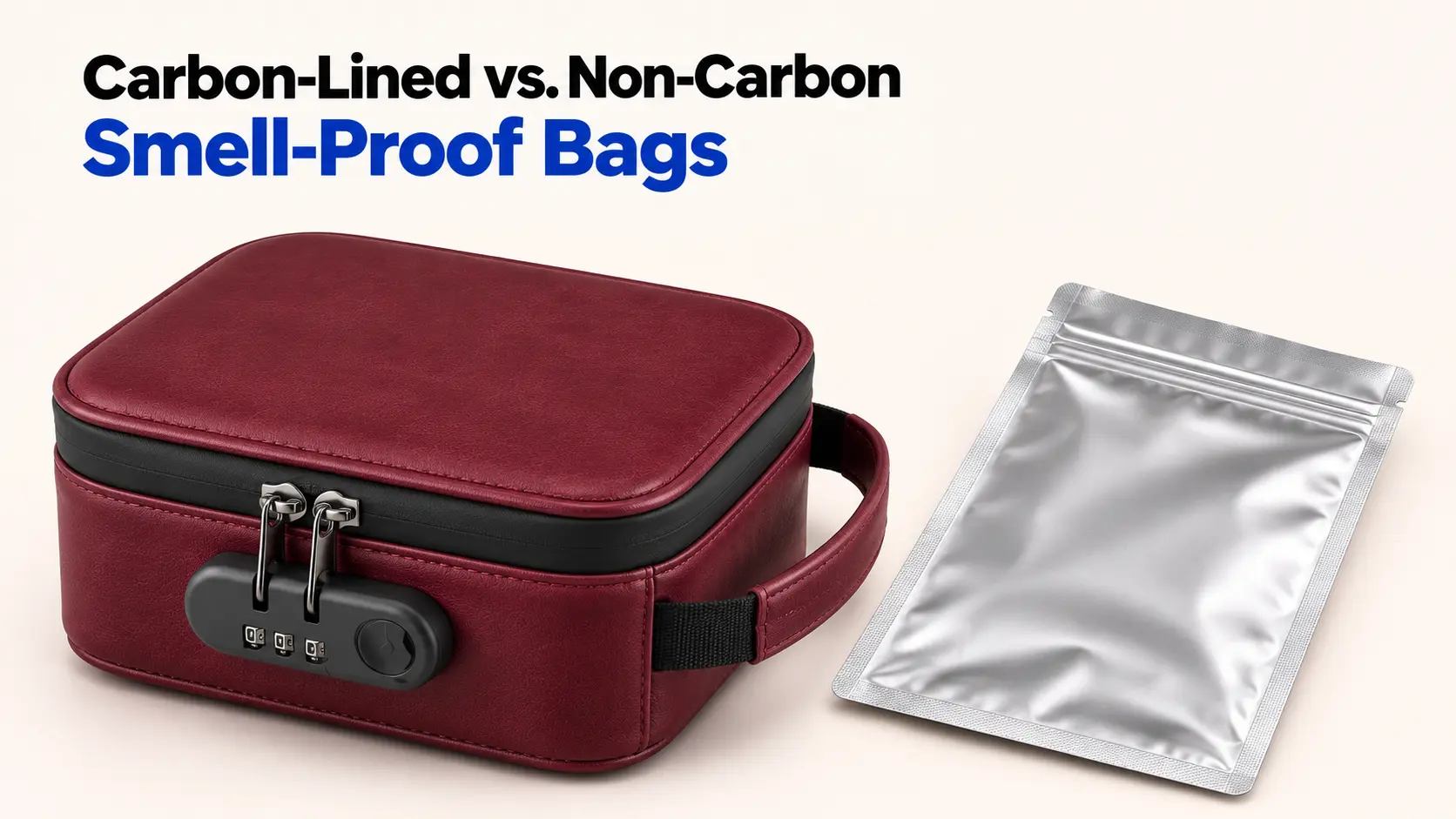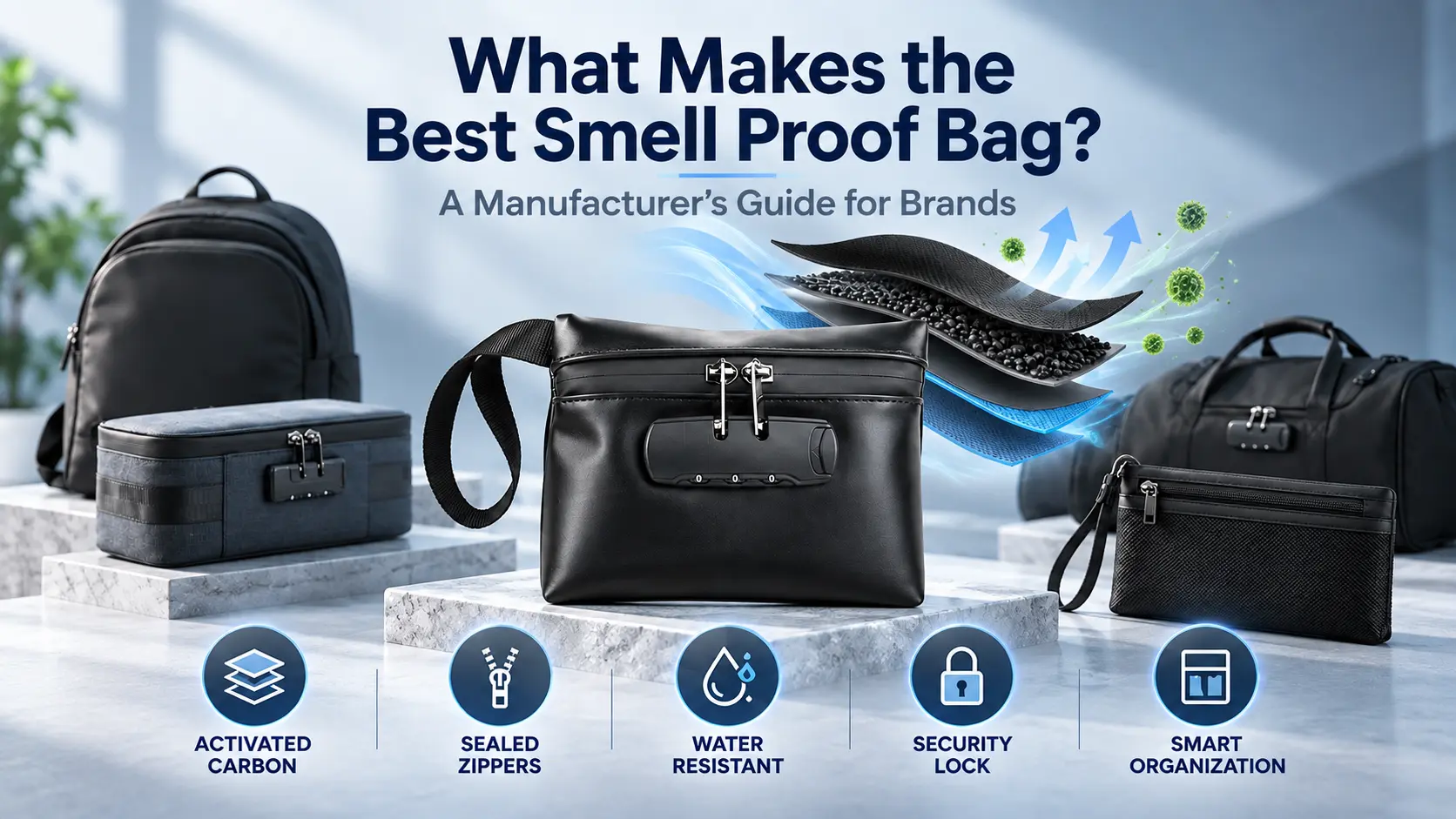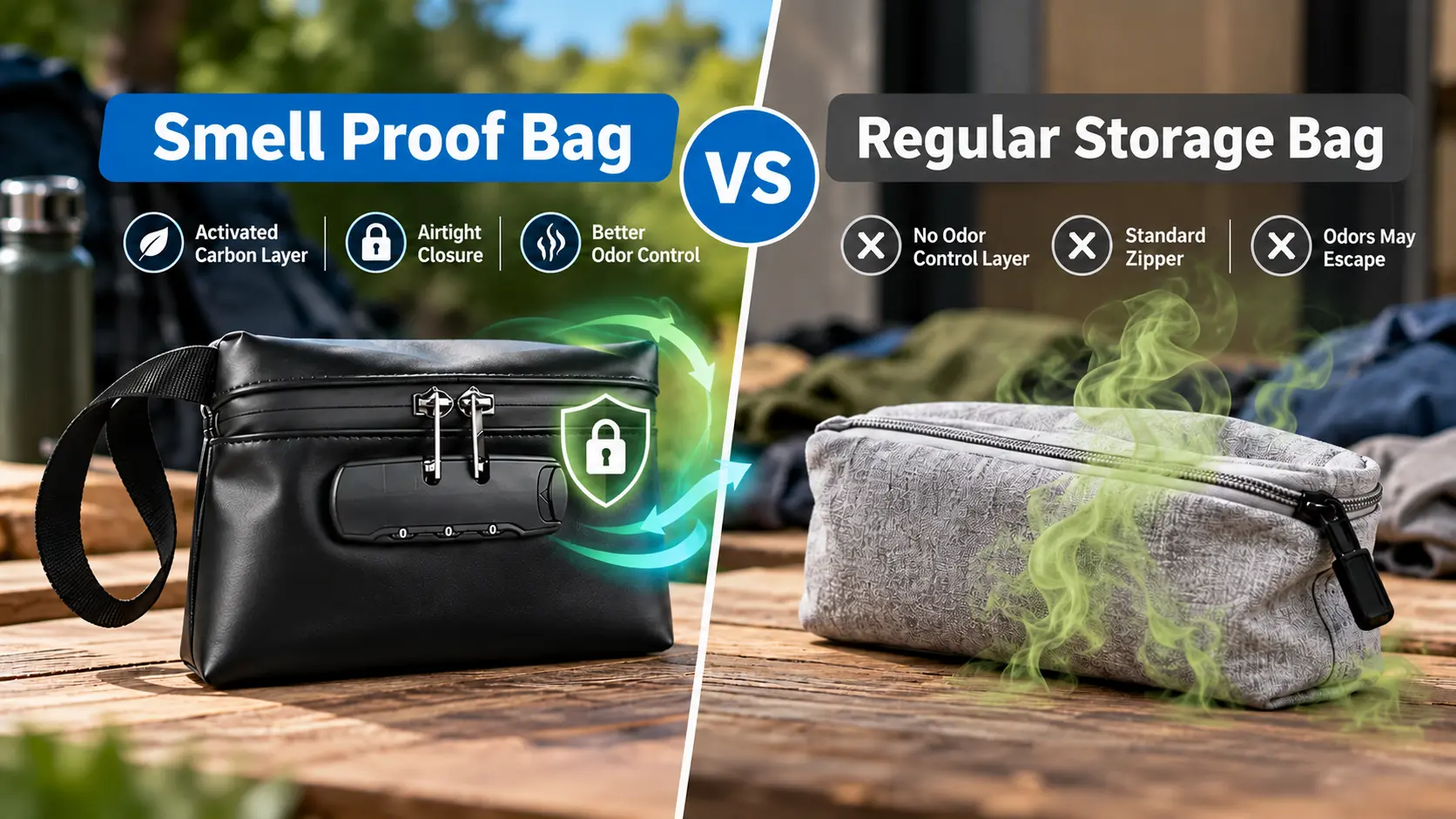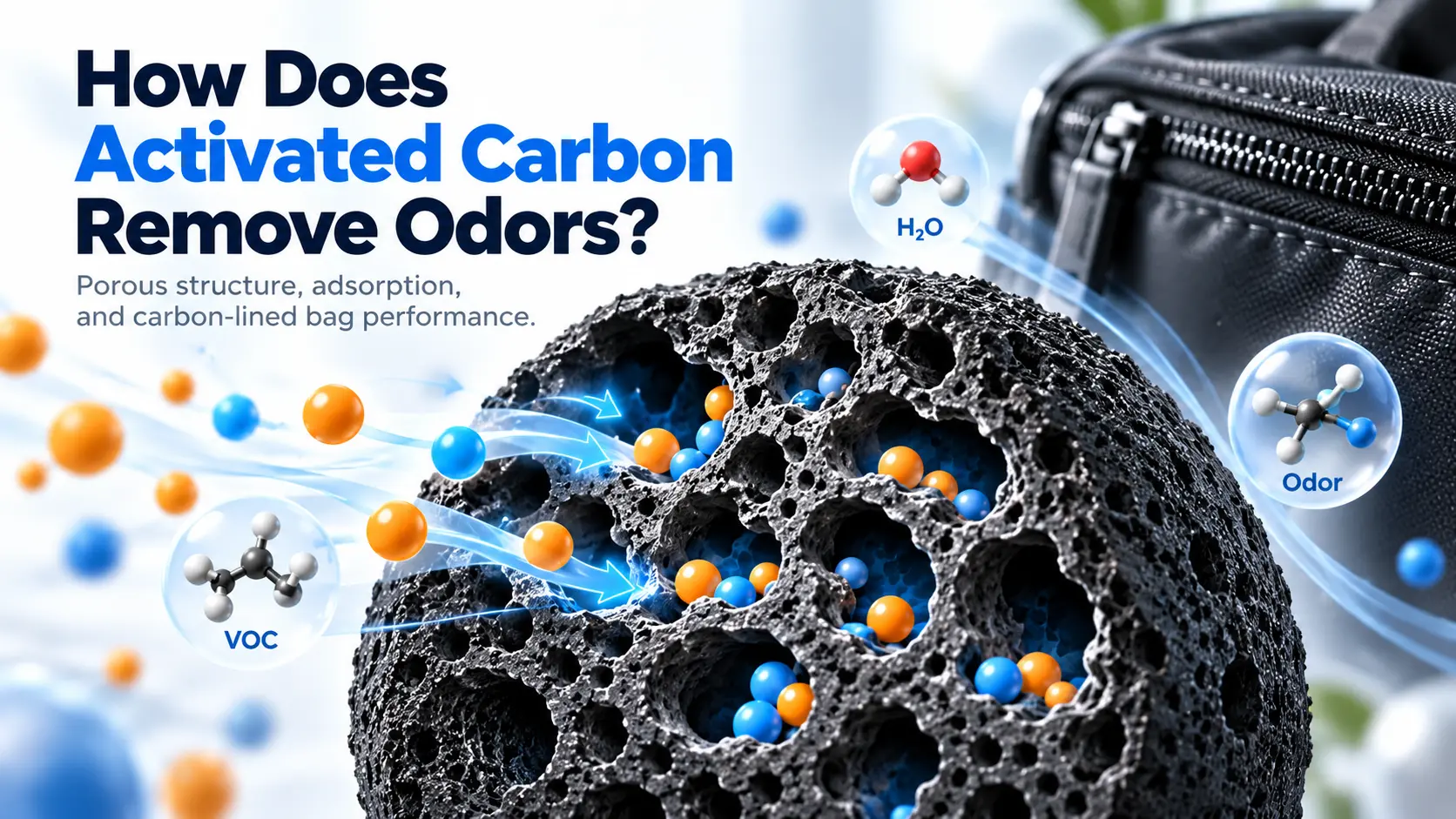
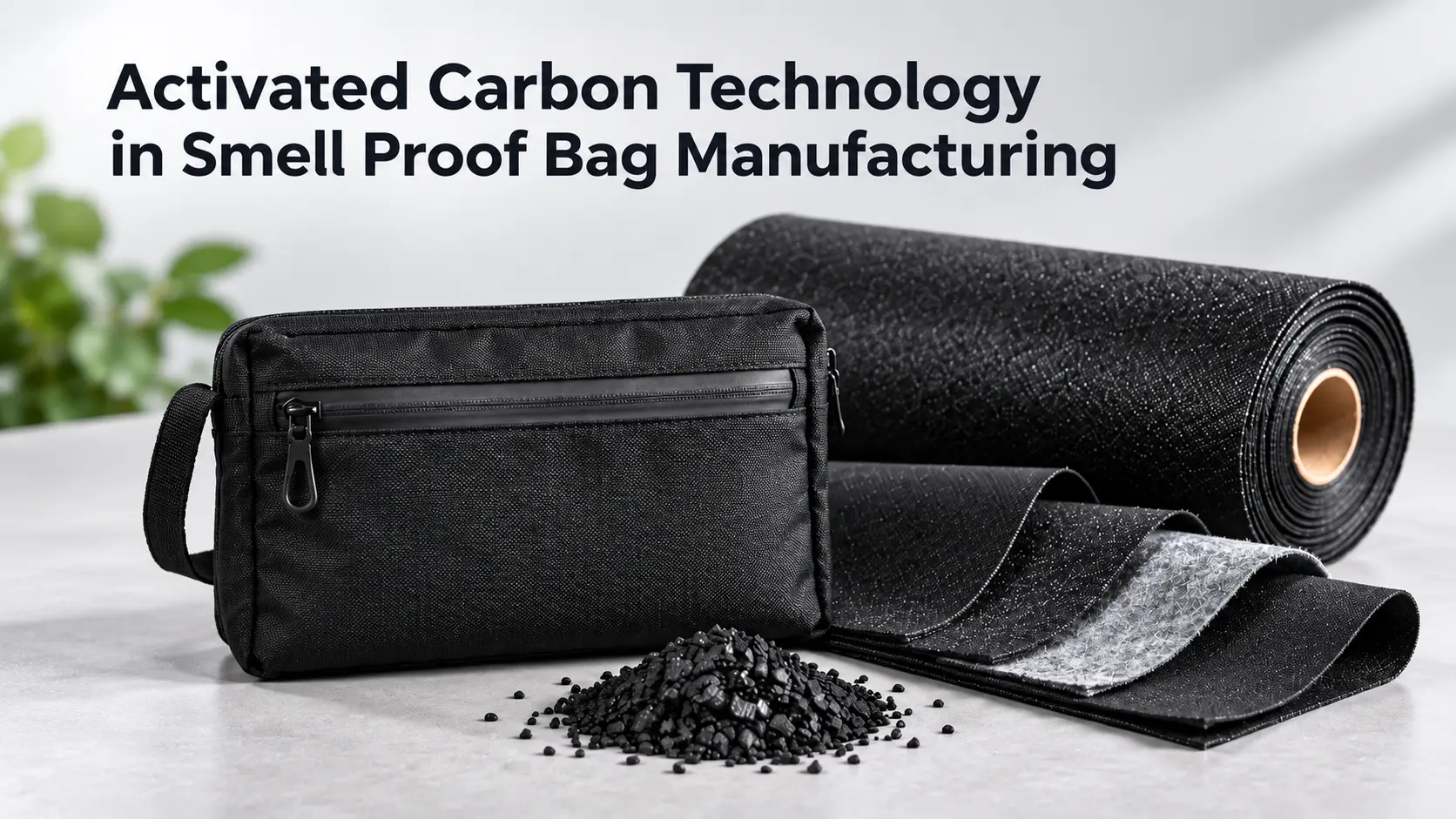
Activated carbon is a familiar material in odor-control products, but turning it into a reliable bag lining involves more than choosing a fabric that absorbs smells. For manufacturers, the real work starts with material specifications, cutting methods, layer integration, and production consistency.
An activated carbon smell proof bag must balance odor-control materials with flexibility, durability, and practical construction. This article focuses on how carbon materials are selected and incorporated into custom bags, and what brands should consider before approving an OEM design.
1. Activated Carbon in Bag Manufacturing: Beyond Basic Odor Adsorption
Activated carbon has a porous structure that adsorbs many odor-causing compounds. However, the material used in a portable bag must also withstand repeated folding, handling, and contact with other fabrics.
Unlike carbon materials used in stationary filtration equipment, flexible bag linings need to fit curved panels, corners, and compact internal compartments without excessive stiffness.
Manufacturers therefore consider several practical requirements:
- Flexibility: The material should accommodate the intended bag shape without unnecessary cracking or stiffness.
- Surface consistency: Carbon distribution should remain reasonably uniform across the usable material.
- Processing compatibility: The lining must be suitable for cutting, assembly, and the selected joining method.
- Material protection: Adjacent fabrics should help limit abrasion and unwanted carbon shedding.
These considerations are particularly important when developing a carbon lined smell proof bag intended for frequent travel or everyday use.
2. Choosing the Right Form of Activated Carbon for Flexible Bags
Activated carbon and activated charcoal are commonly used names for the same class of adsorbent material. For bag manufacturing, the more useful distinction is the physical form in which the carbon is supplied.
Not every carbon material is suitable for flexible textile products.
| Carbon Material | Characteristics | Manufacturing Considerations |
|---|---|---|
| Activated carbon fiber fabric | Flexible material with a carbon-based fibrous structure | Requires suitable handling and protection from wear |
| Carbon-impregnated nonwoven fabric | Carbon incorporated into a nonwoven substrate | Check carbon loading, flexibility, and particle retention |
| Granular activated carbon | Loose particles with varying sizes | Usually requires a separate containment structure |
| Powdered activated carbon | Fine particles with a large exposed surface area | Needs appropriate binding or encapsulation to limit shedding |
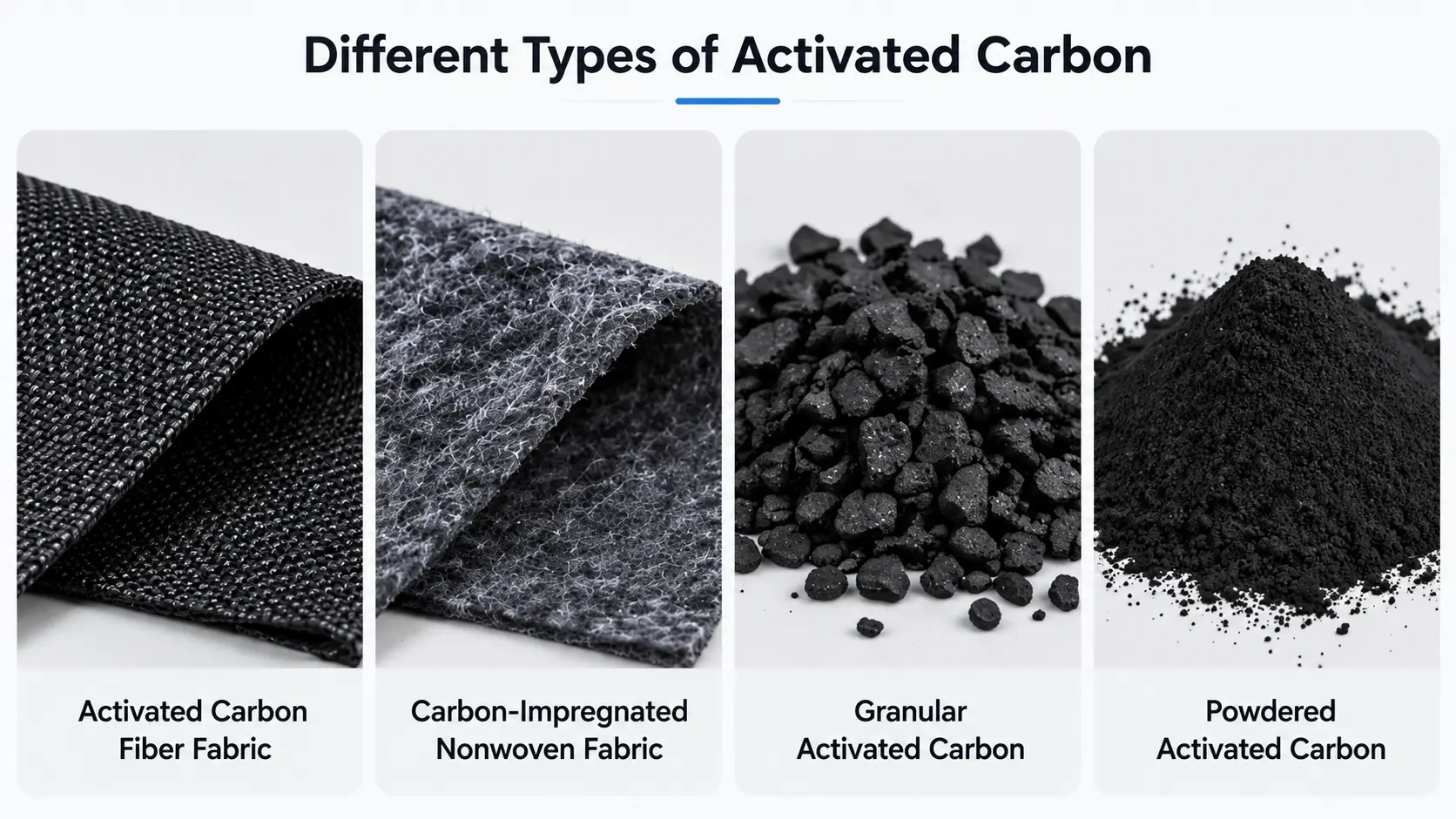
A granular carbon filter bag may work well in certain filtration systems, but loose carbon particles present additional challenges when integrated into a soft travel pouch.
For flexible bags, manufacturers often evaluate fabric-based or composite carbon materials because they can be incorporated into cut-and-sewn panels.
The best choice depends on the intended application, handling requirements, and finished product design. However, activated carbon is only one part of an effective odor-control system. To better understand how smell proof bags work, it’s also important to consider how the carbon lining, sealing components, and overall bag construction work together.
3. Understanding Carbon Loading, Thickness, and Material Specifications
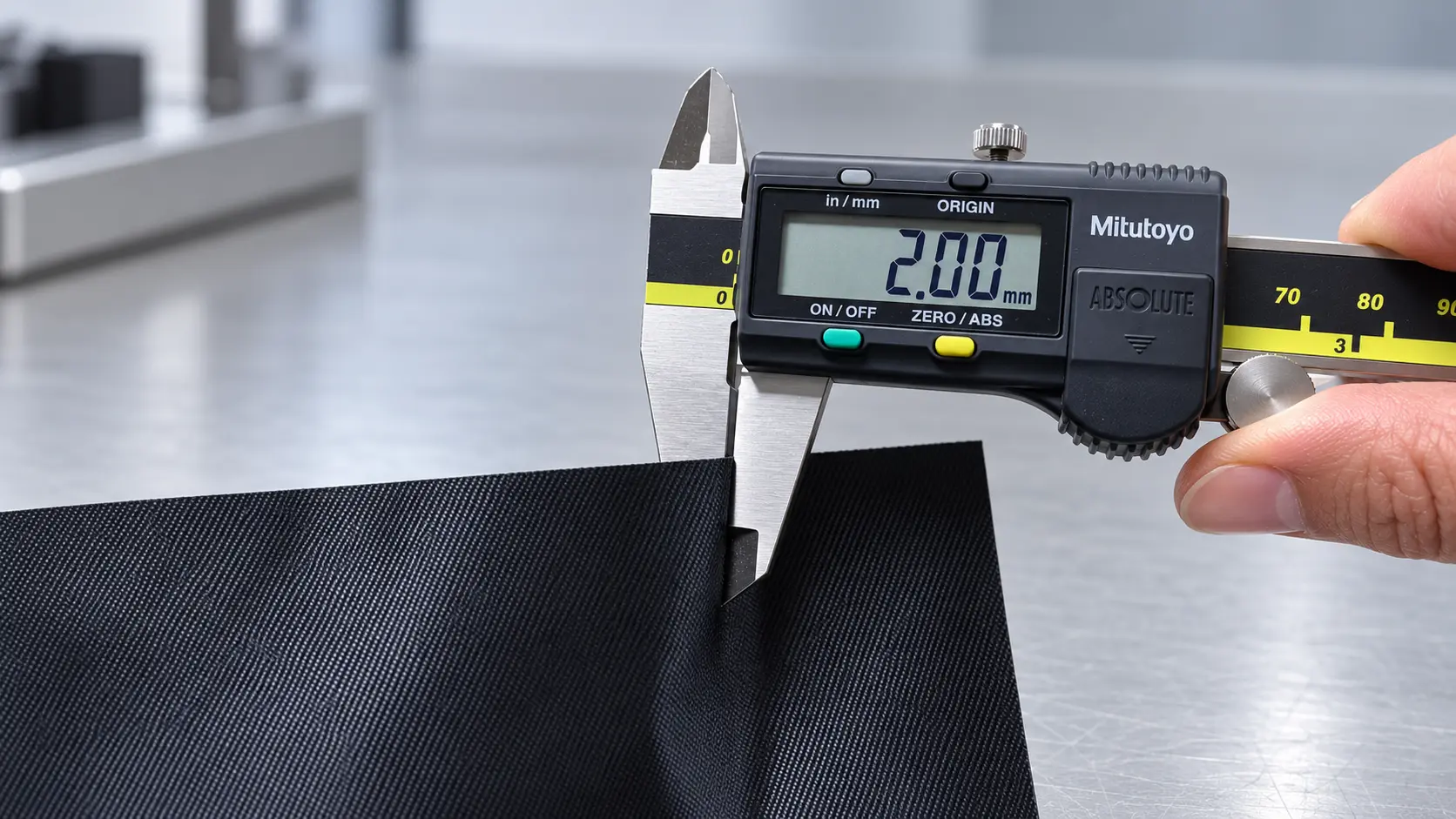
Thickness is one of the first specifications buyers ask about, but it should not be treated as the only measure of material performance.
Two carbon linings with the same thickness may contain different amounts of activated carbon or use different substrate constructions.
When reviewing an activated carbon layer, manufacturers should consider:
- Thickness (mm): Influences the space occupied by the material and how it fits into the bag.
- Basis weight (g/m²): Describes the total material mass per unit area.
- Carbon loading: Indicates the amount of activated carbon present, where this information is available.
- Flexibility: Affects how the material behaves when folded or sewn.
- Layer consistency: Helps reduce variation between different areas of the finished panel.
At TrimLife, we offer a 2mm reactivatable activated carbon lining for selected custom smell proof bag projects.
This construction can be considered alongside different outer fabrics, protective linings, and closure options. However, thickness alone does not establish adsorption capacity or guarantee odor-control performance. This distinction also matters when buyers ask, “do smell proof bags work?” The answer depends on more than carbon thickness, including material quality, closure design, and overall bag construction.
For overseas brands comparing samples, requesting a clear material specification is more useful than relying on a single thickness claim.
4. How Carbon Fabric Is Integrated Into a Bag Lining
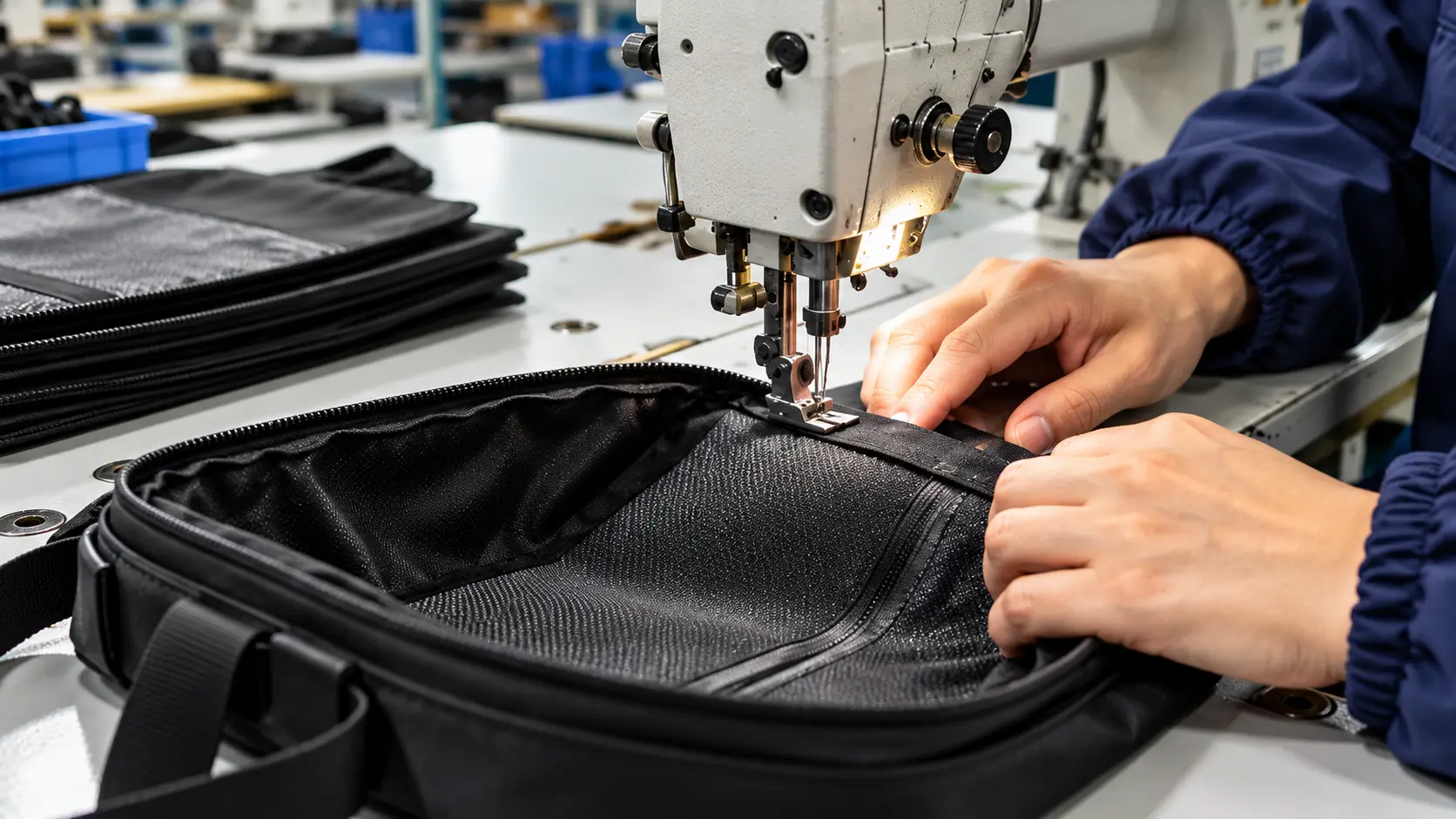
An effective material can still create production difficulties if it is poorly integrated into the finished bag.
The manufacturing challenge is to position the carbon lining correctly while maintaining flexibility and protecting the material during assembly.
Material Cutting
Carbon composite materials should be cut according to the approved pattern and material handling requirements.
Excessive stretching, rough cutting, or unsuitable equipment settings may damage certain substrates or create inconsistent edges.
Layer Alignment
The carbon material and adjacent lining fabrics need to remain properly aligned before final assembly.
Depending on the material construction, suitable lamination, bonding, or mechanical fixing methods may be considered.
Not every activated carbon fabric tolerates the same adhesive, temperature, or processing pressure.
Edge and Seam Construction
Carbon layers may require additional protection near seam allowances, folded edges, and frequently handled areas.
A poorly positioned lining can bunch, shift, or become exposed during repeated use.
For this reason, material compatibility should be reviewed during sampling rather than assumed from the supplier’s specifications.
5. Manufacturing Challenges with Activated Carbon Layers
In practice, a carbon lining introduces several production considerations that ordinary polyester linings may not have.
The most important issues are related to material handling and long-term structural durability.
Repeated bending: Small pouches and foldable bags may experience frequent bending near corners and openings. The selected carbon composite should be evaluated for these conditions.
Carbon shedding: Some carbon-containing materials can release particles when cut or abraded. Appropriate encapsulation or protective construction may help reduce this risk.
Layer separation: Poorly matched bonding materials or processing conditions may affect the stability of laminated components.
Production waste: Carbon composites can have different handling requirements and costs from standard lining fabrics. Efficient pattern layouts help control unnecessary waste.
Dimensional accuracy: Adding a thicker lining changes the space available inside compact bags. Pattern dimensions may need adjustment to maintain the intended internal capacity.
These issues do not mean carbon-lined products are inherently difficult to manufacture. They simply require material-specific decisions before bulk production begins.
6. Carbon Material Inspection and Quality Consistency
A brand approving an activated carbon smell proof bag sample expects the bulk products to use comparable materials and construction.
That expectation starts with clear specifications and continues through material inspection and production control.
A practical quality review may include the following:
| Inspection Area | What to Check |
|---|---|
| Incoming material | Supplier specification, material identity, and visible condition |
| Thickness and weight | Consistency with agreed material tolerances |
| Surface condition | Uneven areas, contamination, or visible material damage |
| Cutting quality | Edge condition and dimensional accuracy |
| Composite integrity | Separation, shifting, or damage after handling |
| Finished assembly | Correct placement and protection of the carbon lining |
Where odor-control performance needs to be demonstrated, brands should agree on suitable test conditions and acceptance criteria before production.
Material adsorption tests and finished-bag odor leakage tests measure different things. Neither should be presented as proof of the other without supporting data.
For repeat orders, retaining approved material samples and recording relevant specifications can help buyers and manufacturers investigate differences between batches.
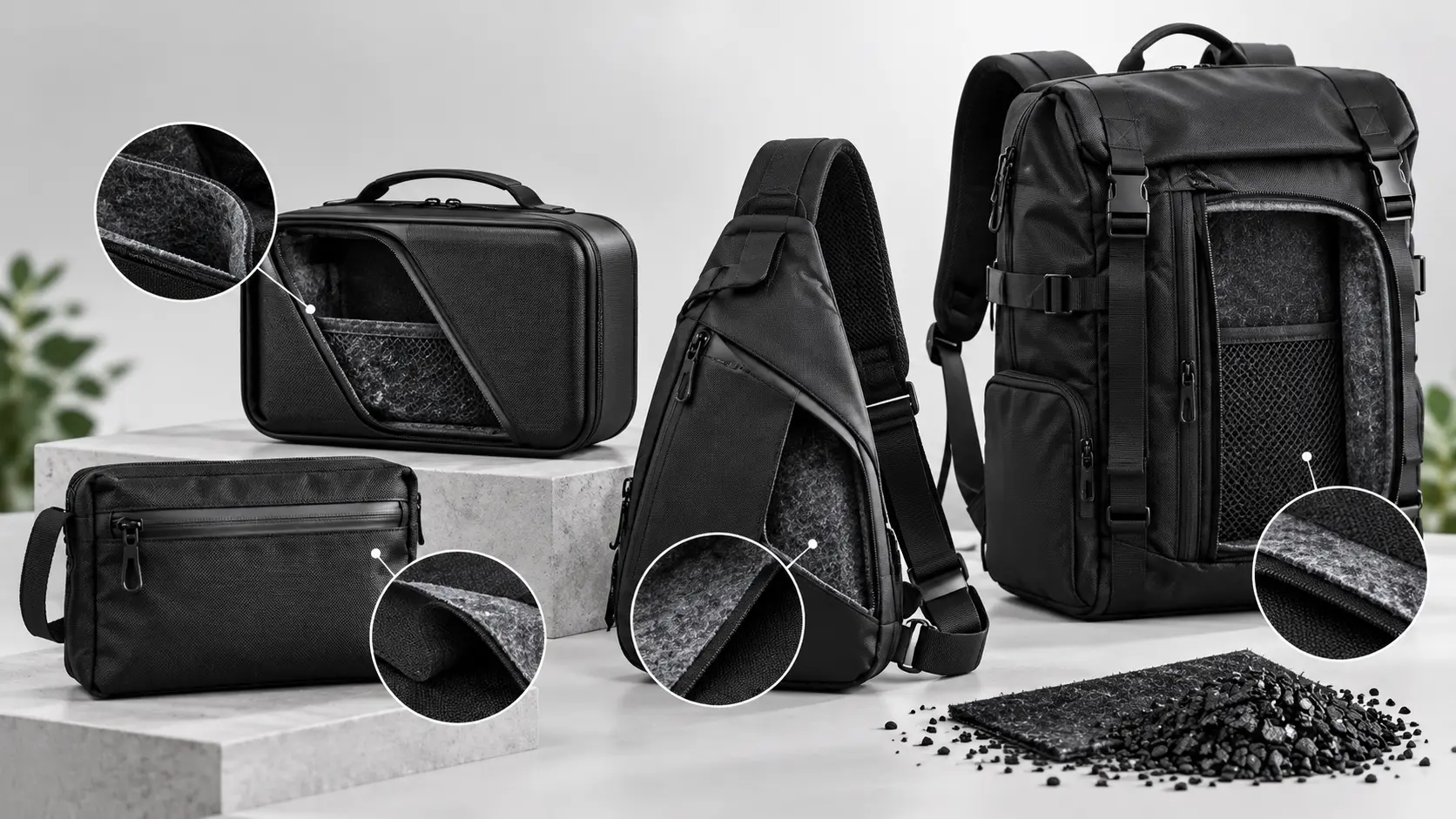
7. Matching Carbon Lining to Different Bag Designs
The same carbon material does not necessarily require the same construction in every product.
Bag size, panel shape, opening design, and intended use all influence how the lining should be incorporated.
Smell Proof Pouches
Compact pouches have limited internal space. Material thickness and seam allowances need careful consideration to avoid reducing usable capacity.
Smell Proof Cases
Structured cases may require carbon materials to work alongside foam, reinforcement panels, or other protective components.
The assembly must accommodate the intended case shape.
Smell Proof Sling Bags
Curved panels and body-contact areas introduce repeated movement. Flexibility and stable lining placement become important design considerations.
Smell Proof Backpacks and Duffel Bags
Larger panels allow different lining layouts but also increase material consumption. Pattern planning and panel consistency can influence manufacturing cost.
For each product, the goal is to match the lining specification to the intended construction rather than automatically selecting the thickest available material.
This approach helps brands evaluate material performance, product usability, and cost together.
8. OEM Development: From Carbon Material Selection to Production
For brands developing a new activated carbon smell proof bag, early material decisions can influence sampling, manufacturing cost, and production feasibility.
A practical OEM development process typically follows several stages.
1. Define the product requirements. Establish the intended bag type, dimensions, construction, target market, and expected use conditions.
2. Review material options. Compare available carbon composites, protective linings, outer fabrics, and compatible accessories.
3. Develop the sample. Prepare a prototype to assess material handling, assembly details, flexibility, and finished dimensions.
4. Refine the construction. Adjust the pattern, carbon layer placement, or joining methods where necessary.
5. Approve the pre-production sample. Confirm materials, workmanship, dimensions, and any agreed testing requirements before bulk production.
At TrimLife, we support OEM/ODM projects with custom bag development, including selected 2mm reactivatable carbon lining options, fabrics, sizes, logos, and closure designs.
Our role is not simply to supply a finished bag, but to help brands make practical material and manufacturing decisions throughout development.
Frequently Asked Questions Activated Carbon Smell Proof Bag Manufacturing
What is the best activated carbon material for smell proof bags?
There is no single best option for every product. Fabric-based and composite carbon materials are often suitable for flexible bags, but buyers should compare carbon loading, handling properties, material stability, and the intended construction.
Is a thicker activated carbon layer always better?
Not necessarily. Greater thickness may allow different material constructions or carbon loading, but adsorption performance also depends on the carbon itself. Thickness should be assessed alongside other specifications and relevant testing.
Can activated carbon lining be reactivated?
Some activated carbon materials can recover part of their adsorption capacity under suitable conditions. However, reactivation depends on the material and surrounding components. TrimLife offers selected reactivatable carbon lining options, but users should follow product-specific care guidance rather than applying high heat or aggressive cleaning methods.
How can brands check carbon lining quality before bulk production?
Buyers can request material specifications, approve physical samples, review construction details, and agree on relevant inspection or testing criteria. Keeping an approved reference sample also helps with repeat-order consistency.
Can manufacturers customize carbon lining for different bag designs?
Yes, subject to material availability and manufacturing feasibility. Carbon lining can be incorporated into different pouch, case, sling bag, and backpack designs. Material coverage, panel construction, flexibility, and overall cost should be reviewed during development.
Develop Your Custom Carbon-Lined Bags with TrimLife
Choosing the right carbon material is only part of developing a reliable product. The way it is cut, protected, assembled, and inspected also matters.
At TrimLife, we work with brands, wholesalers, and distributors on custom smell proof bag projects, offering OEM/ODM support from material selection and sampling through production.
Whether you are developing a compact pouch or a larger travel bag, our team can help you evaluate practical material and construction options.
Have a custom carbon-lined bag project in mind? Contact TrimLife to discuss your design, material requirements, and sampling needs.